
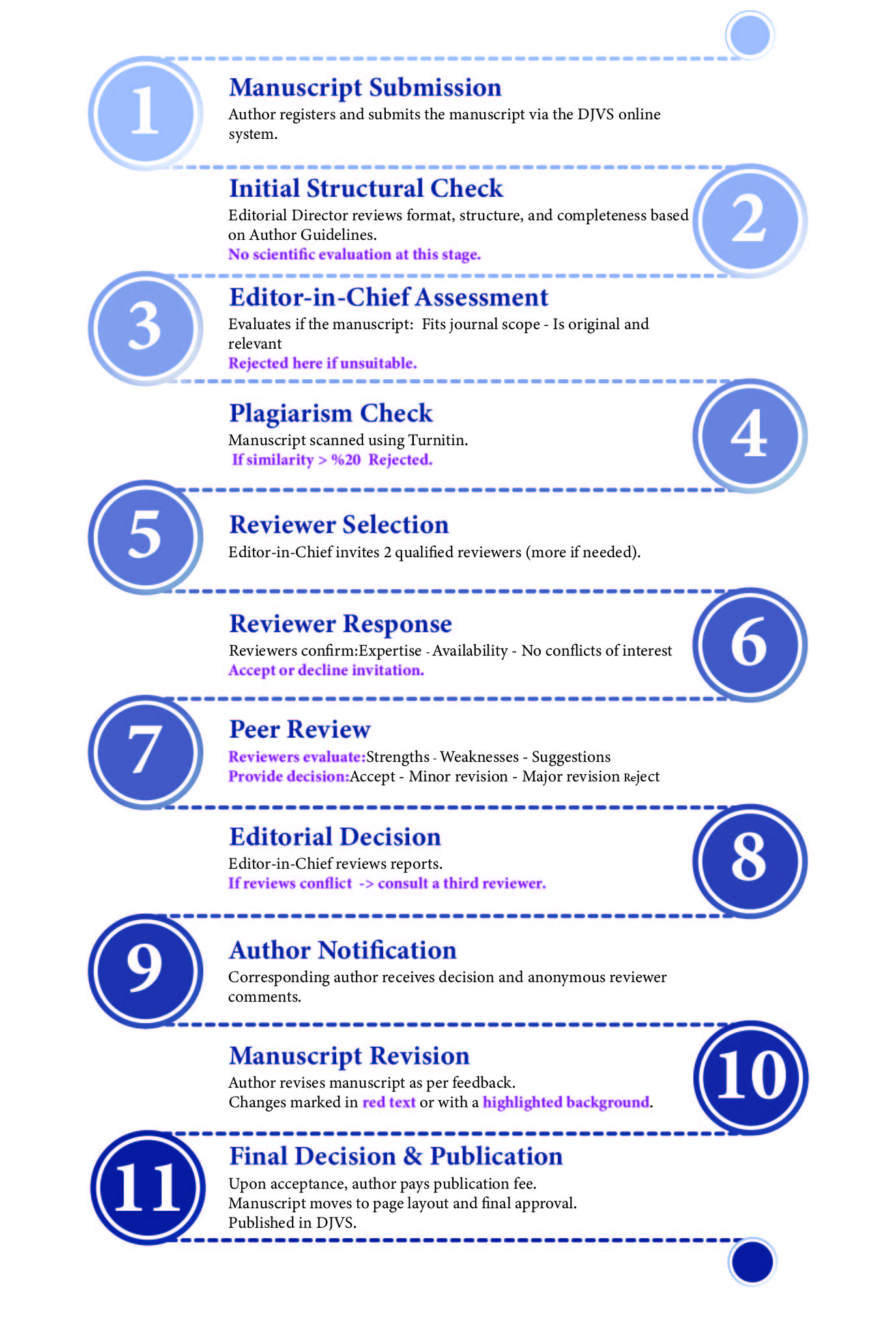
Peer Review Process

The Diyala Journal for Veterinary Sciences (DJVS) follows a double-blind peer-review process. In this system, the identities of both authors and reviewers are kept confidential throughout the review process, as far as reasonably possible, in order to promote fairness, objectivity, and academic integrity.

All manuscripts must be submitted through the journal’s online manuscript management system. Authors are required to create an account and submit all required files in accordance with the journal’s Author Guidelines and manuscript template.

The peer-review process proceeds as follows:

1. Manuscript Submission

The corresponding author, or the submitting author on behalf of all co-authors, submits the manuscript through the DJVS online submission system.

Authors are responsible for ensuring that the submitted manuscript is complete, anonymized where required for double-blind review, and compliant with the journal’s formatting, ethical, and technical requirements.

2. Initial Technical Check

The Editorial Office conducts an initial technical check to verify that the submission complies with the journal’s requirements, including manuscript structure, formatting, required statements, ethical approval where applicable, authorship information, and completeness of submitted files.

No detailed scientific assessment is conducted at this stage.

Submissions that are incomplete or do not comply with the journal’s requirements may be returned to the authors for correction before further editorial evaluation.

3. Editorial Screening

The Editor-in-Chief, or a designated handling editor, evaluates the manuscript to determine whether it falls within the aims and scope of DJVS and whether it has sufficient originality, scientific relevance, and ethical compliance to proceed to peer review.

Manuscripts that are outside the journal’s scope, lack sufficient scientific merit, contain major ethical concerns, or do not meet the journal’s basic editorial standards may be declined without external peer review.

4. Similarity and Originality Screening

All submitted manuscripts are screened for similarity using Turnitin or other appropriate similarity-detection software.

A manuscript with an overall similarity index exceeding 20% may be rejected or returned to the authors for clarification or revision, depending on the nature and source of the similarity.

The similarity percentage is not the only criterion for evaluation. The editorial decision also considers whether the similarity involves properly cited material, methods, references, standard terminology, or inappropriate textual overlap.

Plagiarism, duplicate publication, text recycling without proper citation, or unauthorized use of data, figures, images, or ideas may lead to rejection, correction, expression of concern, or retraction, depending on the stage and severity of the case.

5. Reviewer Selection

Manuscripts that pass the editorial screening are assigned to two or more qualified reviewers with expertise relevant to the subject area of the manuscript.

Reviewers are selected based on their academic qualifications, research experience, independence, and absence of conflicts of interest.

Additional reviewers may be invited when reviewer reports are conflicting, incomplete, or insufficient for making a reliable editorial decision.

6. Reviewer Invitation and Confidentiality

Invited reviewers are asked to confirm their availability, relevant expertise, and absence of any conflict of interest before accepting the review invitation.

Reviewers must treat the manuscript and all related materials as confidential documents. They must not share, copy, distribute, discuss, or use the submitted work for personal advantage.

Reviewers who feel unable to provide an objective or timely review should decline the invitation.

7. Peer Review Evaluation

Reviewers evaluate the manuscript according to its originality, scientific validity, methodology, ethical compliance, clarity, relevance to the field, adequacy of data analysis, interpretation of results, and contribution to veterinary science.

Reviewers are asked to provide constructive, objective, and evidence-based comments that help the authors improve the manuscript.

Reviewer recommendations may include one of the following:

Accept
Minor Revision
Major Revision
Reject

Reviewer recommendations are advisory. The final decision is made by the Editor-in-Chief or the designated handling editor based on the reviewers’ reports, editorial assessment, and journal standards.

8. Language and Presentation Assessment

When necessary, the manuscript may be evaluated for language quality, clarity of expression, academic style, consistency of terminology, and overall presentation.

Language assessment does not replace scientific peer review and does not determine acceptance. Authors may be asked to improve the language and presentation of the manuscript before or after scientific revision.

9. Editorial Decision

After receiving the reviewers’ reports, the Editor-in-Chief or handling editor evaluates the comments and recommendations and makes an editorial decision.

In cases of substantially conflicting reviewer reports, major methodological concerns, or significant ethical questions, the manuscript may be sent to an additional reviewer or discussed further by the editorial team before a final decision is issued.

Possible editorial decisions include:

Accept
Minor Revision
Major Revision
Reject

10. Author Notification

The corresponding author is notified of the editorial decision through the online submission system.

When revisions are requested, anonymized reviewer comments and editorial instructions are provided to the authors.

11. Manuscript Revision

Authors must respond to all reviewer and editorial comments in a clear, respectful, and point-by-point response letter.

Revised manuscripts should clearly indicate all changes made, preferably using track changes, highlighted text, or another method requested by the journal.

Authors should provide scientific justification for any reviewer comment that is not addressed or any suggested change that is not adopted.

Failure to submit a revised manuscript within the specified deadline, without prior communication with the editorial office, may result in withdrawal of the submission from the review process.

12. Final Evaluation and Acceptance

The revised manuscript is evaluated by the Editor-in-Chief, handling editor, and/or reviewers when necessary to ensure that all required revisions have been adequately addressed.

A manuscript is accepted only when it satisfies the journal’s scientific, ethical, editorial, and formatting requirements.

13. Publication Preparation

After acceptance, the manuscript proceeds to copyediting, formatting, proofreading, DOI registration, online publication, and archiving.

The corresponding author may be asked to review the final proof before publication.

14. Article Processing Charge

After acceptance, authors are required to pay the Article Processing Charge in accordance with the journal’s Publication Fees policy.

Payment of the Article Processing Charge has no influence on the peer-review process, editorial evaluation, or acceptance decision.

Submission to accptance steps